


About the Expeditions
The ’85 YEARS ON’ team will unite and complete a series of expeditions aimed at commemorating the 85th anniversaries of 4 epic World War Two events, with the goal of raising £20,000 per-event for our chosen charities.
Click on the pictures below for a short video on each expedition
THE TEAM WILL COMPLETE
2027
Dieppe to St. Nazaire
602km
The Aim of the St Nazaire Raid
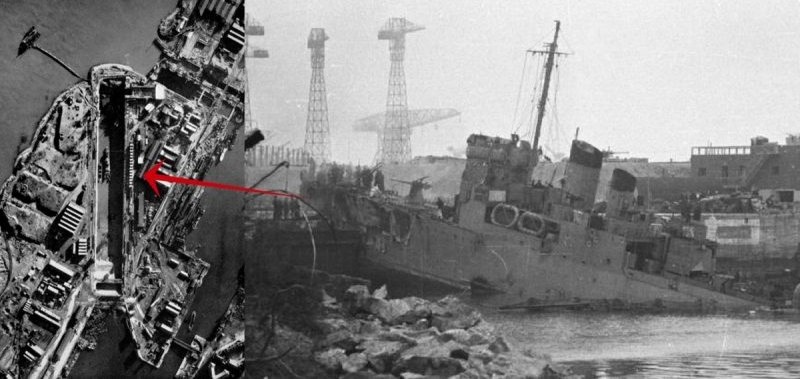
Situated on the west coast of France, the town of St Nazaire was home to a dry dock that had been the largest in the world when it was built in 1932. It was an important strategic asset for the German fleet in World War Two. The dry dock could be used to repair large warships damaged in the Atlantic, where such behemoths as the Bismarck and the Tirpitz had caused grief for the Royal Navy.
By taking out the St Nazaire docks, the British hoped to force large German warships to take a longer route home for repairs elsewhere on the continent. This would not only leave them out of action for longer but also force them to pass through the heavily defended seas around Britain, where the Royal Navy and Air Force could finish them off.
The Strike Force
The forces for the attack consisted of 265 Commandos and 346 Royal Navy personnel.
Central to the plan was HMS Campbeltown, a First World War-era destroyer that had been obtained from the American navy in 1940. Stripped of much of its equipment, it was fitted with extra armour at the bow, which was filled with 4.5 tonnes of high explosives. The chimney stacks were cut to make it look more like a German ship during its approach.
Accompanying the Campbeltown were two destroyers and a flotilla of motorboats, some to provide fire support and others to transport personnel out at the end of the raid.
Ramming the Docks
On the night of 27 March 1942, the improbable happened.
At 23:30, British bombers began attacking the port, drawing German searchlights and anti-aircraft fire. Unusual behaviour by the bombers caused the Germans to suspect that something was amiss. At 01:00 on 28th March, the guns ceased firing and spotlights were shut off, rather than help the British identify where the port was in the darkness.
It was too late. The British had already entered the Loire estuary. At 01:22 the German spotlights were switched on again, this time illuminating the British convoy minutes out from the coast.
Identifying themselves as friendly ships, the British gained a few more moments to approach, but the Germans swiftly saw through the deception. Every gun on the docks opened fire.
The Campbeltown lost two helmsmen as it approached the shore – one dead and one wounded. At 01:34 she hit the dock gates at a speed of 19 knots, the impact driving her 33 feet onto them.
The explosives, timed to trigger after British personnel had escaped, sat waiting in the bow.
The stranded commandos charged across a bridge from St Nazaire’s old town to its new town and tried to fight their wait out through the narrow streets. But they were hugely outnumbered, running low on ammunition, and soon surrounded. At last, with all the ammunition gone, they surrendered.
A handful of men escaped. These five commandos made their way south with the help of French civilians. Eventually reaching neutral Spain, they returned from there to England.
Aftermath
Several tense hours followed the fighting. The explosives aboard the Campbeltown were meant to trigger at 04:30 but did not, possibly because of a problem with the fuses. A growing number of British soldiers held captive at German headquarters waited to see if their work would pay off.
Around noon, a group of senior German officers and civilians were inspecting the Campbeltown, unaware of the danger she contained. Without warning, the bow exploded, killing them and 320 others. The dry dock was destroyed and remained out of action for the rest of the war.
The raid had been a success, but at a huge cost. Of 622 men who took part, 169 were killed and 215 captured. 89 decorations were awarded for the daring service of the men who took part in the raid.

2028
F-Force March
295km
F-Force:
Background & Deployment on the Thai-Burma Railway
“Many sick men, too sick to heed prodding rifle buts
or bayonets. They were almost asleep on their feet. I left them with a sick feeling in my stomach. We had at least become slowly immune to the conditions, but “H” and “F” parties were being treated infinitely worse than us. They were new to it all, they couldn’t even make an atap hut or bamboo cooking fire.”
In early 1943, the Japanese accelerated construction of the Thai-Burma Railway to establish a secure land supply route between Thailand and Burma. To meet a revised completion deadline, they requested an additional 10,000 prisoners of war to provide labour, leading to the creation of F-Force & H-Force.
F-Force was formed in April 1943 and consisted of approximately 7,000 Allied POWs. Men were encouraged to volunteer after being promised improved living and working conditions, but upon arrival in Thailand they were instead forced to undertake a gruelling 300-kilometre march north to remote railway camps.
Administratively, F-Force was designated the 4th Branch of POWs under Lieutenant Colonel Banno Hirateru and assigned the letter “F” by the Japanese POW Administration. Although the prisoners remained under the control of the Malaya POW Administration, they were also subject to the authority of the Japanese 5th Railway Regiment, creating complex and often ineffective chains of command.
F-Force was deployed in the challenging northern sector of the railway, where shortages of food, medicine, transport and sanitation were common. The fragmented Japanese command structure frequently resulted in neglect and hardship for the prisoners. Many members of F-Force endured severe disease, malnutrition, exhausting labour and brutal treatment while working to complete one of the most demanding sections of the railway.
Today, F-Force is remembered for the extraordinary resilience, endurance and sacrifice of its men, many of whom suffered or died during the construction of the Thai-Burma Railway in 1943.
2029
D-Day North, East, South, West
1220km
D-Day, the British People and the 85 Years On Commemorative Walk
On 6 June 1944, Allied forces launched D-Day, the largest amphibious invasion in history, landing on the beaches of Normandy and beginning the liberation of Western Europe from Nazi occupation. The success of the operation depended not only on the bravery of the servicemen who fought on the beaches, but also on the sacrifice and endurance of millions of ordinary people across the British Isles throughout the Second World War.
For almost six years, the British people endured bombing campaigns, rationing, blackouts, the separation of families, evacuation of children, and the constant threat of invasion. Communities worked tirelessly in factories, shipyards, farms and military installations to support the war effort. Men and women from every corner of the United Kingdom contributed to the eventual success of D-Day, whether serving in uniform or supporting the war effort at home.
The ‘85 YEARS ON’ team will honour both the fighting forces and the civilians whose collective efforts made D-Day possible and ultimately played a pivotal part in the Victory on Europe. Their route has been designed to represent the contribution of the entire British Isles, symbolically linking the North, West, East and South before concluding at Sword Beach, where British troops landed on D-Day.
THE FOUR NATIONS ROUTE
North – Scapa Flow, Orkney
The wartime home of the Royal Navy’s Home Fleet and one of Britain’s most important naval anchorages, representing the northern contribution to victory.
West – Belfast
A city central to wartime shipbuilding, naval support and industrial production, representing the western contribution of the British Isles.
East – RAF Duxford
One of the most significant RAF fighter stations of the Second World War and a symbol of Britain’s air power and defence.
South – HMS Victory, Portsmouth
Portsmouth served as a principal embarkation point for forces heading to Normandy, while HMS Victory represents Britain’s enduring maritime heritage and naval strength.
THE ‘85 YEARS ON’ ROUTE
- Scapa Flow to Belfast
- Belfast to RAF Duxford
- RAF Duxford to HMS Victory, Portsmouth
- HMS Victory, Portsmouth to Sword Beach, Normandy
By travelling from the far north of the British Isles to the shores of Normandy, the ‘85 YEARS ON’ team will pay tribute to the sailors, soldiers, airmen and civilians whose resilience, determination and sacrifice secured freedom in Europe. The journey reflects the unity of a nation at war, recognising that victory on D-Day was achieved not only by those who landed on the beaches, but by an entire generation that endured hardship, loss and uncertainty at home in support of the Allied cause.
2030
Sandakan to Ranau Death March
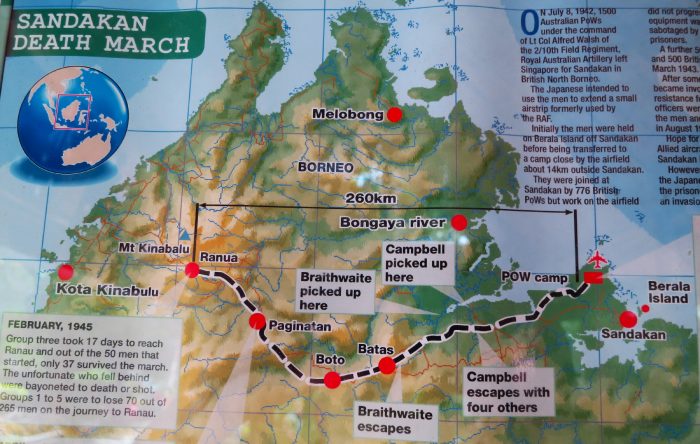
260km
The Sandakan to Ranau death marches were a series of brutal forced marches in Borneo during World War II, resulting in the deaths of nearly all 2,434 Allied prisoners of war, with only six Australians surviving.
Background
The Sandakan POW camp in North Borneo (now Sabah, Malaysia) held Australian and British soldiers captured during the Fall of Singapore in February 1942. The prisoners were forced by the Japanese to construct a military airstrip under harsh conditions, with severe malnutrition, disease, and abuse being commonplace. By early 1945, the camp held over 2,500 prisoners, including 1,793 Australians and 641 British soldiers.
The Death Marches
In January 1945, fearing an Allied invasion, the Japanese began relocating prisoners from Sandakan to Ranau, approximately 260 kilometres inland. The first march involved 470 prisoners, forced to traverse swamps, rivers, dense jungle, and the eastern slopes of Mount Kinabalu. The journey, intended to take nine days, provided rations for only four, and those unable to continue were executed or left to die. Survivors were forced to construct temporary camps under unsanitary conditions, where disease and starvation claimed most of them.
A second series of marches began in May 1945 with around 536 prisoners. These marches lasted 26 days, with even fewer rations and harsher conditions. Prisoners were often forced to forage for food, and those who collapsed were killed. A third march in June left no survivors.
Casualties and Survivors
Of the 2,434 prisoners who began the marches, fewer than 100 reached Ranau alive, and only six Australians ultimately survived by escaping. The mortality rate exceeded 88%, making it one of the deadliest atrocities against servicemen during World War II
The expedition will start and finish with acts of Remembrance to commemorate the 85th Anniversaries of all the original operations.